skip to main |
skip to sidebar
On a day when religious people observe the Resurrection of Jesus Christ and chocoholics are indulging in their annual chocolate orgy, some of us in Newcastle celebrate Easter Sunday in a display of pure grunt and muscle power.
 Not just any muscle, but with the toughest of them all ... the Ford Mustang, a car that celebrates big block normally aspirated V8 engines, wide rubber, tons of chrome, 4 speed 'top loader' manual transmissions and a car the fuelled the dreams of every boy growing up in the 60's and 70's.
Newcastle was lucky enough to host the 2012 Mustang National over the Easter, with over 300 of these iconic American muscle cars from the Mustang Owners Club Association of NSW on display, including a 1982 SSP Mustang, a Mustang Ute and every kind of Mustang in between.
 Out of all the Mustangs on display my favourites were the beautiful 1969 Shelby 350 GT, the last of iconic Carroll Shelby produced Mustangs and the awesome 'Big Red', a 1967 Shelby GT 500 with the massive 428ci (7 Litre) engine to make this beast the mother of all Mustangs!
But there was not just motoring muscle on display in Newcastle on Easter Sunday ... playing at the nearby Ausgrid Stadium was the Round 6 clash of the National Rugby League competition, where human muscle was on display. The local team, the Newcastle Knights were playing the Parramatta Eels in a dour struggle. After 80mins of hard slog in warm autumn sunshine the Newcastle Knights were eventually victorious 14 - 6 and kept themselves in the hunt for the finals come September.
So even if you can't play Rugby League, or don't own a Mustang, you can still come to Newcastle and pursue some other leisurely such as whale watching, wine tasting or just soaking up the sun on some of Australia's best beaches .... beats sitting at home sucking eggs!
After our dismal summer, it has been great to actually get out and about, doing things that make the week at work bearable.
What is even better when you get to share those moments with people you love.
 Saturday dawned to a fine and warm early autumn day, not scorching hot, but still warm enough to visit Nobbys Beach. It was made even better because my grand-daughter was visiting and so we headed down to make the most of the last of the sun, surf and sand. The temperature was still around 25 deg. and the water temperature was still around the low 20's, which made a late, late season swim quite pleasant experience ..... something I missed out on during our summer of sorrows.
 Sunday was also a copy of Saturday, fine and mild. So it was off to a community planting day, organised by the local council to help stabilise a local creek that has recently been reclaimed from invasive non native plants. So for two hours, we dug, planted, mulched and watered new plants to help our local environment and our local community.
After our free breakfast, it was then off to Kurri Kurri and to wander around the 9th Annual Nostalgia Festival. Rock 'n' Roll music, classic cars, Rock 'n' Roll music, hot rods, Rock 'n' Roll music, market stalls, Rock 'n' Roll music ... all combined to make the day a wonderful adventure, a real step back in time to the 50's and 60's era ... oh and did I mention the Rock 'n' Roll music?
Sometimes it is great to get some 'me' time on the weekends, however it is better when you can share your weekends with family, community .... and Rock 'n' Roll music.

Summer Sucks!
Not really, but the normal lazy, hazy, crazy of an Aussie summer was almost non existent as the Australian east coast came under the influence of a La Niña weather pattern which bought a strong southerly air flow which produced wet and unseasonably cool weather. That was not to say we didn't have some great summer weather, however, it must be said those days were far and very few in between.
So I'd like to say farewell to our Bummer Summer and hopefully we will catch up with a sunny Newcastle summer next season.
One of the most devestating things that can happen to a community is when it tears itself apart over a trivial issue and then for that issue to create a longer term community divide.
 Such an issue has polarised my town of Newcastle over of all things, trees! Yep, the 14 Laman Street fig trees have driven a political wedge into the community, with the Save Our Figs (Greens/Social Alliance) on one side and the Newcastle City Council on the other.
Now trees are important to any community and they should be highly valued, however, as with anything, they should be closely assessed for suitability to the urban environment, The local city council assessed the Laman Street trees and for better or worse they concluded that the time had come for their replacement. The trees were around 80 years old, their invasive root system was severely compromising the underground utilities, also, the same root system had severely damaged the road pavement and the figs themselves had not just the nasty habit of unpredictable branch failure, but also of total tree collapse (as evidenced during the 2007 'Pasha' storm). The detritus of the fig trees also clogged drains, created numerous slip/trip hazards and with the bird and bat (flying fox) excrement in abundance it made a visit to the Newcastle cultural precinct a decidedly unpleasant event. However, for all their faults they really did look wonderful, their enormous canopy provide wedding photographers with a wonderful backdrop and the dappled shade provided nearly the perfect lighting for capturing the happy couples wedding day. A lot of local Novacastrians grew up with the trees and so the figs formed quite an emotional bond with a lot of older residents, so It seemed that those who thought they held the most memories also believed that they held the final say in any decision on the future of the trees. The Laman Street fig tree's had become very important touchstones to peoples memories of a bygone age in Newcastle.

So it wasn't surprising that when the local council decided that the time was nigh for the figs, that the shit most certainly was going to hit the fan and it would cause deep divisions within the city as both sides settled in for a long, protracted fight. The big difference in this fight, as opposed to other fights with the council over development issues in the past, is that this time the local council wasn't dominated by the old ALP (Australian Labor Party) or a loose collection of left wing misfits, but had a majority of councillors that were of an independent and or, of a right wing persuasion (or for want of a better description, 'no crap' politicians).So when the decision was made to remove the figs and the vote taken, from that day there was no turning back.
So at 5.45am on the 31st January the chainsaw moved in and the trees came down, with the 14 figs felled to the stump and mulched to woodchip by Tuesday 7th February.
 Personally I was for the removal as I saw that Laman Street had become a dirty rut riddled rat run that was not showcasing the cities unique architecture as I believed it should be presented to visitors. I, and a lot of other ratepayers, saw the redevelopment of the cultural precinct as a vital step in the cities revitalisation as a visitor destination (Newcastle is currently ranked by the Lonely Planet guide in the Top 10 of must visit destinations) and now the trees now removed the Art Gallery, Library and the Baptist Tabernacle are able project their differing architectural styles to the world, instead of being hidden by the fig trees.
 Unlike a lot of opinions, my favourite building is the War Memorial Cultural Centre (opened in 1957) it now dominates the landscape above Civic Park and now free of the fig trees it is reinstated as one of Newcastle's most important buildings of the last century. One thing I never noticed with the building is the unique colouring of the sandstone, when I first viewed the building without the foliage the sandstone looked almost like pink paint primer and it is not until I got close that I actually noticed that it is in fact the hue of the sandstone that gives the building a unique look.
 The building on western side of the Cultural Centre is the Baptist Tabernacle which was opened in 1889 and it was designed by the renowned architect Frederick Menkens (1855 - 1910). Menkens designed the Laman St facade in a neo-classical Corinthinan style that reflected the Classical Revivalist style that was coming in vogue during the late 19th century. It should be noted that apart for the very ornate Laman Street frontage, the rest of the building is designed in a very utilitarian manner to save on costs ... gotta love those very sensible Baptists! With the foliage removed from the from the front of this wonderful building all of Newcastle can see what a wonderful piece of architectural heritage has been retained.
 The Baptist Tabernacle is in direct contrast to the Newcastle Regional Art Gallery which is located on the eastern side of the Cultural Centre and is an example of modernist architecture in the Brutalist Architecture style that came in vogue during the late 1970's, the Newcastle City Administration Centre is also another example of this type of angular geometric style. The Newcastle Regional Gallery which was formerly opened by Queen Elizabeth II on the 11th March 1977 is earmarked for redevelopment and expansion along with the changes earmarked for Laman Street refurbishment.
But no matter what the end outcome of the redevelopment is, the psyche of Newcastle community has been changed and it will take a lot of time before the healing process can begin. Perhaps as a community we can take solace from the Lyndon Dadswell bronze sculpture in the foyer of the Cultural Centre which represents "youth emerging from the conflict of war and looking with hope and courage to the future"
 When I was a kid growing up in one of the sprawling suburbs on Australia's east coast, our summer started for us kids on the Labor Day Long Weekend which is celebrated on the first weekend in October and from that weekend on it was Stubbies (a popular kind of shorts), thongs (double pluggers), surf, sand, sunburn, Beach Boys tunes and girls. This Australian rite of passage usually continued right up until Easter Long Weekend. Yes, those were the lazy halcyon days of my youth.
What happened to summer?
Last year we had a late start to summer with the warmer weather not really kicking in till the week before Christmas and playing out until late April. Once again this year we have had a late to our summer, with the warmer weather waiting until New Years to bless us. Even then it has been a patchy start to 2012, with a few hot days in between the dominant southerly air stream, that have bought patchy showers and cooler temperatures. To emphasise the point, December 2011 was the coldest recorded in 50 years with an average mean temperature of just 19.9º and with only an average 6.7 hours per day, down from the usual 7.9 hours, which added to the gloom.
What happened to summer?
 But it is not all doom and gloom, I don't think I have ever seen my garden looking so lush and verdant at this time of year ... ever! Usually by January the gardens are really struggling, as the moisture evaporates with hand watering and heavy mulching the only way that the avid gardener can keep his garden from desiccating before their eyes. However, not this summer, the whole garden is alve with new growth, especicially the frangipanis which are producing flowers en masse, the like I have never seen before.
What happened to summer?
 Although my garden is in picture perfect condition, a wet summer has its drawbacks as well, like the vines in the Pokolbin vineyards area not setting the fruit, which could lead to a smaller crop and a poorer vintage this season. Another drawback is the lack of beach days, where I get to spend lazy days reading good books and soaking up the sun on some of Australia best suburban beaches and worrying about how to keep my camera free of sand. But not this summer, beach days have been a rare event and movies have been the preferred weekend outing.
What happened to summer?
So what happened to summer, I don't know, perhaps next year we'll get one .... and then we can complain about the drought, bushfires, water restrictions and a brown lawn.
Ahhh, the vineyards of Polkolbin in the spring time can be quite picturesque with lush verdant vines thriving in the warm Australian sunshine.
.... What !!!
Well normally this would be the case, however springtime in Australia, especially in New South Wales, can be extremely temperamental, with wild swings in temperature and weather conditions, especially in the current La Nina conditions. And believe me this week certainly proved the point as to the changability of our weather.
As the week started out it was hot and humid and quite uncomfortable. However, by Wednesday morning the heavens had opened up over the Hunter and dropped over 80 millimetres, which is over 3 inches in old speak, of much welcomed rain over the district. So while our summer is just around the corner, a cold snap such as the one we are experiencing at the moment, can have you wondering why you packed away your winter weight jumper and wet weather gear so early, brrrr
Although the dams can always use a much needed top up, working in the constant precipitation is not much fun and dodging the constant deluges can try the patience of a saint ... or an Australia Post transport driver.
As Charles Dudley Warner famously said, although mistakenly attributed to Mark Twain, "everyone complains about the weather, but nobody does anything about it"
However, I just think I'll just let Enya take us out with -
It's In The Rain
 Every time the rain comes down,
close my eyes and listen.
I can hear the lonesome sound
of the sky as it cries.
Listen to the rain...
Here it comes again...
Hear it in the rain...
Feel the touch of tears that fall,
they won't fall forever.
In the way the day will flow,
all things come, all things go.
Listen to the rain...
(the rain...)
Here it comes again...
(a-gain...)
Hear it in the rain...
(the rain...)
Late at night I drift away
I can hear you calling,
and my name is in the rain,
leaves on trees whispering,
deep blue sea's mysteries.
Even when this moment ends,
can't let go this feeling.
Everything will come again
in the sound, falling down,
of the sky as it cries.
Hear my name in the rain.
'In The Rain' lyrics Roma Ryan courtesy 2005 EMI Music Publishing Ltd - www.enya.com
In 1973 the Daily Mirror newspaper described Ingleburn as a "wasteland" dominated by "ugliness, lack of amenities and boredom". As a teenager growing up in the suburb at the time I was absolutely gobsmacked that anyone would describe my town in such vitriolic manner and also as a result of that article, I don't even think my mother has bought a Murdoch published newspaper for nearly 40 years!

However, history existed right under our noses if we cared to suspend our prejudices, remove our blinkers and just look at our own town.
 The development of Ingleburn can be traced back to colonial botanist, George Caley, who in 1805 traveled from Prospect across to the upper reaches of the Georges River mapping its course near Ingleburn. Not long after the travels of Caley, settlers pushed out of the Sydney confines and into the area that is now known as Ingleburn. In 1809 four soldiers, William Hall, William Neale, Joshua Alliot and Timothy Loughin from the NSW Corps took up farm selections in the area that became known as Soldiers Flat, on the eastern side of Bunburry Curran Creek (according to Parish Maps of the late 1830's show that Bunburry is spelt with 2 r's and not with one 'r' as it is today). Although the southern railway came through in 1858, it wasn't until 1869 that a rail platform was built on the Neale property to service the growing rural industries and so a name had to be found for the new locality. The name chosen was Macquarie Fields, named after the large property located on William Redfern's land holdings to the north of the platform. The properties near the platform changed hands a few times up until 1881 when the area was purchased by Elias Laycock and the home he built on his new holdings was called Ingleburn House. Also in 1881 William Redfern's former Macquarie Fields property was subdiivided and became the new village of Macquarie Fields. To save confusion over the names in August 1883 the railway authorities decided to adopt the name of the nearby Elias Laycocks house, so the name was changed to Ingleburn. When the area around the station was eventually subdivided, the area simply became known as Ingleburn as well.
As Ingleburn was basically a rural village, most of the early buildings were constructed using easily accessible building materials such as timber and iron. Even the local public school, which was relocated from Brooks Point near Appin and opened in 1887 was originally built as a timber and iron structure. The current brick building, including the teachers residence, that stands on the site today were constructed in 1892 at a cost of £1097/9/0 ($1.6 million) which reflects the standing Ingleburn had achieved in it's very short history.
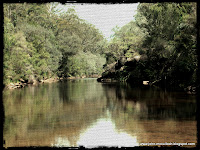
 Ingleburn even managed their own civic affairs when they elected their own council and which first sat in1896. The first meetings were conducted in Alderman Smiths lounge room (as there was no council chambers at the time) with Mr Barff serving as Ingleburn's first Lord Mayor. Also serving were some old Ingleburian names such as Mr Percival and Mr Collins (the areas first Postmaster) who were elected as Alderman in the first local administration. Eventually the council was incorporated into the Campbelltown Council in 1948. One of the legacies of the Ingleburn Council was the development of Kings Park (now called the Georges River Reserve) in the late 30's as a recreation area and was popular spot for swimming on those hot summer days. It was also where a lot of local kids, myself included, learnt to swim, mainly thanks to the now heritage listed weir that made the conditions less treacherous by artificially slowing down the fast flowing water. The area was also used extensively by the Scouting movement for orienteering and bush related activities, a real asset to the early community before the age of swimming pools.
 In 1901, the original railway station burnt to the ground and so the government decided that it would be one of the first built in the contemporary style of the day, that is in what is known as the 'Initial Island' style. Ingleburn railway is one of the few remaining examples of the first attempts to implement this style of rail architecture into the Sydney metro area and is considered to be the prototype for many other railway station buildings that were erected in the 1910 -20 period using this style.
The Ingleburn School of Arts (Community Hall) is another example of pride in local community, built in the 1920's it is an example of the Art Deco style that was becoming in vogue around that time. The hall has survived during this time, however a recent redevelopment of the Ingleburn Arts Precinct, saw the old hall demolished and now only the facade remains.
It was during the 1970's that population of the former rural village exploded, when the Housing Commission and developers opened up vast tracts of farmland to housing and changed the face of my town forever, dragging the locals from a sleepy insular backwater, to a thriving Sydney suburb. However, what puts Ingleburn apart for other suburbs in south west Sydney is that Ingleburn has a very rich civic and architectural history ... all you have to do is look.
N.B. - I'd like to thank the Campbelltown City Library, the online resources of the National Library of Australia, the late Ingleburn historian Mrs Genevieve Tregear & my 4th Form history teacher Miss Burrows, who gave me my inspiration ... better late than never!.

 Not just any muscle, but with the toughest of them all ... the Ford Mustang, a car that celebrates big block normally aspirated V8 engines, wide rubber, tons of chrome, 4 speed 'top loader' manual transmissions and a car the fuelled the dreams of every boy growing up in the 60's and 70's.
 Out of all the Mustangs on display my favourites were the beautiful 1969 Shelby 350 GT, the last of iconic Carroll Shelby produced Mustangs and the awesome 'Big Red', a 1967 Shelby GT 500 with the massive 428ci (7 Litre) engine to make this beast the mother of all Mustangs!


